Friday, April 23, 2010

Wednesday, April 21, 2010
Calling myself out: student learning, linguistic privilege, gratitude
Today I got an email from a first-year student in the living-learning program for which I am a graduate assistant/assistant director. He was about to register for our sophomore capstone course and was trying to choose a section based on which professor, in my view, would be "an easy teacher or grader."
I will not tell a lie. My first reaction was one of amused annoyance. Asking a staff/faculty member to tell you who the easy teacher is? Unbelievable. "What a classic millennial moment," I thought. "Let me just post this on Facebook - my colleagues and friends in the higher ed world will love this."

With that out of my system, it was time to respond to the student. I know him fairly well -- he's a first-generation college student and non-native speaker of English who puts an extraordinary amount of time into his academic work. So I was surprised and somewhat disappointed, not just at receiving an email like this (oh, millennials...), but at receiving it from him. I wrote:
"I hope you are doing well. It's nice to hear from you, but this was a surprising email to get from you - as you are an extremely hard-working person who takes coursework seriously, and not a person who I see as wanting to seek out the easy route. And in this case, there probably will not be one, as both instructors will work very hard to offer a challenging but fun learning experience in the course. I encourage you to see this course as a learning opportunity and not a chance for an easy A - it will be a challenging course no matter who teaches it."
His response - I won't paste it verbatim here, because I don't have his permission. But he said, with an anxious tone, that he was really worried about this writing-intensive course. He "did not really 'properly' learn English" as a kid, he reminded me, and shared that he's frustrated by always getting the same grade on writing assignments, no matter how hard he tries.
Whoa. MY BAD. His goal: writing A-papers, so he can earn an A in the course, so he can maintain a high GPA, so he can graduate near the top of his class, so he can get a great job, so he can bring honor to his family, showing them that the sacrifices they've made for his education have all been worth it. My goal: offering a "teachable moment" about the importance of seeking out challenging learning experiences...as if I've had a single day in my educational life when I haven't been grade-conscious; as if I had any idea what it might be like to write and speak all day long in a non-native tongue.
Step one...follow-up email sharing that I hear him loud and clear, honoring his experience, talking about the writing center, sharing resources on academic writing for college students who are non-native speakers of English...doing and saying all the right things.
Step two...calling myself out, big time...lovingly and constructively. This is what it means to explore the wreck. It's not about guilt, shame, or blame. It's not about sitting here wishing I hadn't posted to Facebook, or feeling ashamed for finding humor in a student e-mail message. It's about exploring the wreck...working through layers upon layers of (educational/upper middle class/white) privilege so that I learn, with gratitude, all that this student has to teach me.
I will not tell a lie. My first reaction was one of amused annoyance. Asking a staff/faculty member to tell you who the easy teacher is? Unbelievable. "What a classic millennial moment," I thought. "Let me just post this on Facebook - my colleagues and friends in the higher ed world will love this."

With that out of my system, it was time to respond to the student. I know him fairly well -- he's a first-generation college student and non-native speaker of English who puts an extraordinary amount of time into his academic work. So I was surprised and somewhat disappointed, not just at receiving an email like this (oh, millennials...), but at receiving it from him. I wrote:
"I hope you are doing well. It's nice to hear from you, but this was a surprising email to get from you - as you are an extremely hard-working person who takes coursework seriously, and not a person who I see as wanting to seek out the easy route. And in this case, there probably will not be one, as both instructors will work very hard to offer a challenging but fun learning experience in the course. I encourage you to see this course as a learning opportunity and not a chance for an easy A - it will be a challenging course no matter who teaches it."
His response - I won't paste it verbatim here, because I don't have his permission. But he said, with an anxious tone, that he was really worried about this writing-intensive course. He "did not really 'properly' learn English" as a kid, he reminded me, and shared that he's frustrated by always getting the same grade on writing assignments, no matter how hard he tries.
Whoa. MY BAD. His goal: writing A-papers, so he can earn an A in the course, so he can maintain a high GPA, so he can graduate near the top of his class, so he can get a great job, so he can bring honor to his family, showing them that the sacrifices they've made for his education have all been worth it. My goal: offering a "teachable moment" about the importance of seeking out challenging learning experiences...as if I've had a single day in my educational life when I haven't been grade-conscious; as if I had any idea what it might be like to write and speak all day long in a non-native tongue.
Step one...follow-up email sharing that I hear him loud and clear, honoring his experience, talking about the writing center, sharing resources on academic writing for college students who are non-native speakers of English...doing and saying all the right things.
Step two...calling myself out, big time...lovingly and constructively. This is what it means to explore the wreck. It's not about guilt, shame, or blame. It's not about sitting here wishing I hadn't posted to Facebook, or feeling ashamed for finding humor in a student e-mail message. It's about exploring the wreck...working through layers upon layers of (educational/upper middle class/white) privilege so that I learn, with gratitude, all that this student has to teach me.
Monday, April 19, 2010
OK, maybe I don't need to post *every* day...
...just more often.
Why, at the end of every semester, do I fantasize about dropping everything and becoming a contemporary folk/American singer-songwriter? All insights welcome.
Why, at the end of every semester, do I fantasize about dropping everything and becoming a contemporary folk/American singer-songwriter? All insights welcome.
Saturday, April 17, 2010
Oopsie. Missed a day.
But I'm back.
I'm thinking about...
I'm thinking about...
- the theory/practice divide in higher education.
- identity construction among white women working against racism.
- what it means to leave a place where one is deeply rooted.
- my fantastic mother-in-love, Jan Robbins, and how badly I still miss her every day, almost two years after her death.
- how deeply personal my research interests have turned out to be.
- About why we're all so allergic to pollen? How long have people had plant allergies? Is it a post-industrial phenomenon? Did we destroy our respiratory systems with machines?
Thursday, April 15, 2010
Jumping in...
Okay. I refused to be one of those people who sucks at writing blog entries. But it's time to come clean: I'm deeply ambivalent.
On the one hand, I feel like an old lady, because I definitely have a voice in me that says blogs, Facebook, Twitter, blah blah blah - that's for self-centered people who think their random thoughts are worth other people's time.
On the other hand, I need to force myself to get my words out there, get into the daily practice of putting words on the page, and knowing I have followers (hi followers!), no matter how few, will help keep me accountable.
So here's the deal. I will post here every day for one week. Period. And we'll see how it goes. I will stop censoring and editing myself, waiting for something "blog-worthy" that isn't too private to share or the time to write a friggin' dissertation about a news item. This will be my Gen X/Gen Y cusper - version of Twitter (which I TOTALLY can't deal with...even though I'm all up in Facebook like it's my job).
Entry for today? Check. Come back tomorrow. Let's see if it gets interesting.
And, for the sake of documenting a bittersweet day, some words from Marvin Bell:
On the one hand, I feel like an old lady, because I definitely have a voice in me that says blogs, Facebook, Twitter, blah blah blah - that's for self-centered people who think their random thoughts are worth other people's time.
On the other hand, I need to force myself to get my words out there, get into the daily practice of putting words on the page, and knowing I have followers (hi followers!), no matter how few, will help keep me accountable.
So here's the deal. I will post here every day for one week. Period. And we'll see how it goes. I will stop censoring and editing myself, waiting for something "blog-worthy" that isn't too private to share or the time to write a friggin' dissertation about a news item. This will be my Gen X/Gen Y cusper - version of Twitter (which I TOTALLY can't deal with...even though I'm all up in Facebook like it's my job).
Entry for today? Check. Come back tomorrow. Let's see if it gets interesting.
And, for the sake of documenting a bittersweet day, some words from Marvin Bell:
| Around Us | ||
| by Marvin Bell | ||
We need some pines to assuage the darkness when it blankets the mind, we need a silvery stream that banks as smoothly as a plane's wing, and a worn bed of needles to pad the rumble that fills the mind, and a blur or two of a wild thing that sees and is not seen. We need these things between appointments, after work, and, if we keep them, then someone someday, lying down after a walk and supper, with the fire hole wet down, the whole night sky set at a particular time, without numbers or hours, will cause a little sound of thanks--a zipper or a snap-- to close round the moment and the thought of whatever good we did. | ||
Sunday, February 14, 2010
Remembering Jim Crow
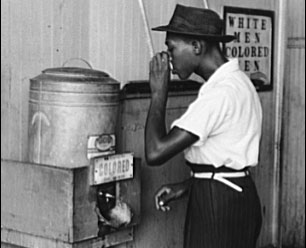
During my drive home today I heard a rebroadcast of this amazing radio documentary chronicling Black and White Americans' memories of the Jim Crow days in the South. It's a collaboration of American RadioWorks and the Behind the Veil project of the Center for Documentary Studies (yeah Durham/Duke!). And it blew my mind.
The project website is great. According to a History Matters page (written by Jim Crespino of Emory University) on the history of Jim Crow:
"The site is produced in conjunction with a multimedia book project of the same name (2001) edited by William H. Chafe, Raymond Gavins, and Robert Korstad. Material for the Web documentary, as well as for a radio documentary that aired on National Public Radio (and which is available through this site), is drawn largely from interviews in the mid-1990s with members of the last living generation of African Americans to reach adulthood in the era of legalized racial segregation."
What I found most stunning about "Remembering Jim Crow" was the section entitled "Whites Remember Jim Crow." Not surprisingly, Whites in the southwestern Lousiana town of New Iberia recalled segregation days in profoundly different terms than African Americans. "Our Negroes were happy," said longtime Iberia Parish resident Mary Levaux, recalling cheerful smiles among plantation workers, seemingly joyous gospel melodies rising from Black churches, and a perception that Blacks adored and looked up to Whites because they "knew where their bread was buttered."
Now, it's not that this kind of thinking is new to me. It's just that this documentary was so well done -- and such a profound reminder of the depths of White people's cognitive dissonance about racism (the previous link will take you to antiracist educator Tim Wise's 2006 essay, "'Eracing' Katrina: Historical Revisionism and the Denial of the Obvious" -- to close the reflections-on-race-in-Lousiana loop.)
I'm reminded anew of my responsibility as an antiracist educator to interrogate White privilege in my own everyday life and the institutions with which I interact.
"...racial disparities matter, and...they tell us how far removed we are from the equal opportunity society we profess to be, against all evidence to the contrary." - Tim Wise, Eracing' Katrina...
Thursday, February 11, 2010
"Diving Into the Wreck"
I first read Adrienne Rich's poem, "Diving Into the Wreck," late one night a few years ago when I was reading poetry on the Internet, a favorite procrastination technique and bedtime winding-down activity. Poetry is an old friend, a quiet wonder, and a spiritual roadmap. It synthesizes and creates meaning, bridges the aesthetic and the scientific, and renews my faith in what is possible when the mind, the heart, and the pen come together.
Rich's gorgeous poetic voice has lit my way before, most recently five years ago at my partner's and my commitment celebration when our friend read an excerpt from "21 Love Poems." That poem at once celebrated our union and troubled the grand narrative of heterosexual romantic love that has done us all so much damage. For me, "21 Love Poems" became a symbol of hope for new possibilities in life and love.
When I came across "Diving Into the Wreck," I was seeking hope of a slightly different flavor. I was a new doctoral student, excited almost beyond reason about the prospect of spending most of my time reading, writing, and thinking, but I also felt desperately adrift. Everyone else seemed to know what they were doing. They had all already read the right things and met the right people. They had research ideas or at least faked them well. They seemed ready to make big decisions, write long papers, get things done. They were, in a word, anchored.
Or at least I thought so at the time.
Since then, I've discovered this little secret about academia: we're all making it up as we go along. We come to explore. We come to discover. We come to learn. Sometimes our hearts are broken, our progress is slowed, our hopes are dashed -- yet we keep going, pushing aside debris and detritus, slowly making our way toward something that, eventually, starts to feel like home.
In short, we've come to explore the wreck.
I am one diver. This is my story.
Rich's gorgeous poetic voice has lit my way before, most recently five years ago at my partner's and my commitment celebration when our friend read an excerpt from "21 Love Poems." That poem at once celebrated our union and troubled the grand narrative of heterosexual romantic love that has done us all so much damage. For me, "21 Love Poems" became a symbol of hope for new possibilities in life and love.
When I came across "Diving Into the Wreck," I was seeking hope of a slightly different flavor. I was a new doctoral student, excited almost beyond reason about the prospect of spending most of my time reading, writing, and thinking, but I also felt desperately adrift. Everyone else seemed to know what they were doing. They had all already read the right things and met the right people. They had research ideas or at least faked them well. They seemed ready to make big decisions, write long papers, get things done. They were, in a word, anchored.
Or at least I thought so at the time.
Since then, I've discovered this little secret about academia: we're all making it up as we go along. We come to explore. We come to discover. We come to learn. Sometimes our hearts are broken, our progress is slowed, our hopes are dashed -- yet we keep going, pushing aside debris and detritus, slowly making our way toward something that, eventually, starts to feel like home.
In short, we've come to explore the wreck.
I am one diver. This is my story.
Subscribe to:
Posts (Atom)